
SLS printing
Want to have strong, functional parts 3D printed with high accuracy? SLS printing (Selective Laser Sintering) is the solution for demanding applications in industry. Thanks to this technique, you can produce complex shapes without support material, with short delivery times and consistent quality. At Rapid Prototyping, we have years of experience with SLS 3D printing specifically for the manufacturing industry. For more questions, please contact contact with us or schedule a consultation in.

Fast and accurate
Our processes are designed for speed without compromising on precision. This provides you with functional models that fit exactly within your design at lightning speed.

Affordable
We combine efficient production with smart planning, so you never pay too much. That way you get the most out of your budget, with no surprises afterwards.
Good quality
Our parts meet high standards and are suitable for functional testing and end use. Every detail is checked for dimensional accuracy, finish and strength.


What is SLS 3D printing?
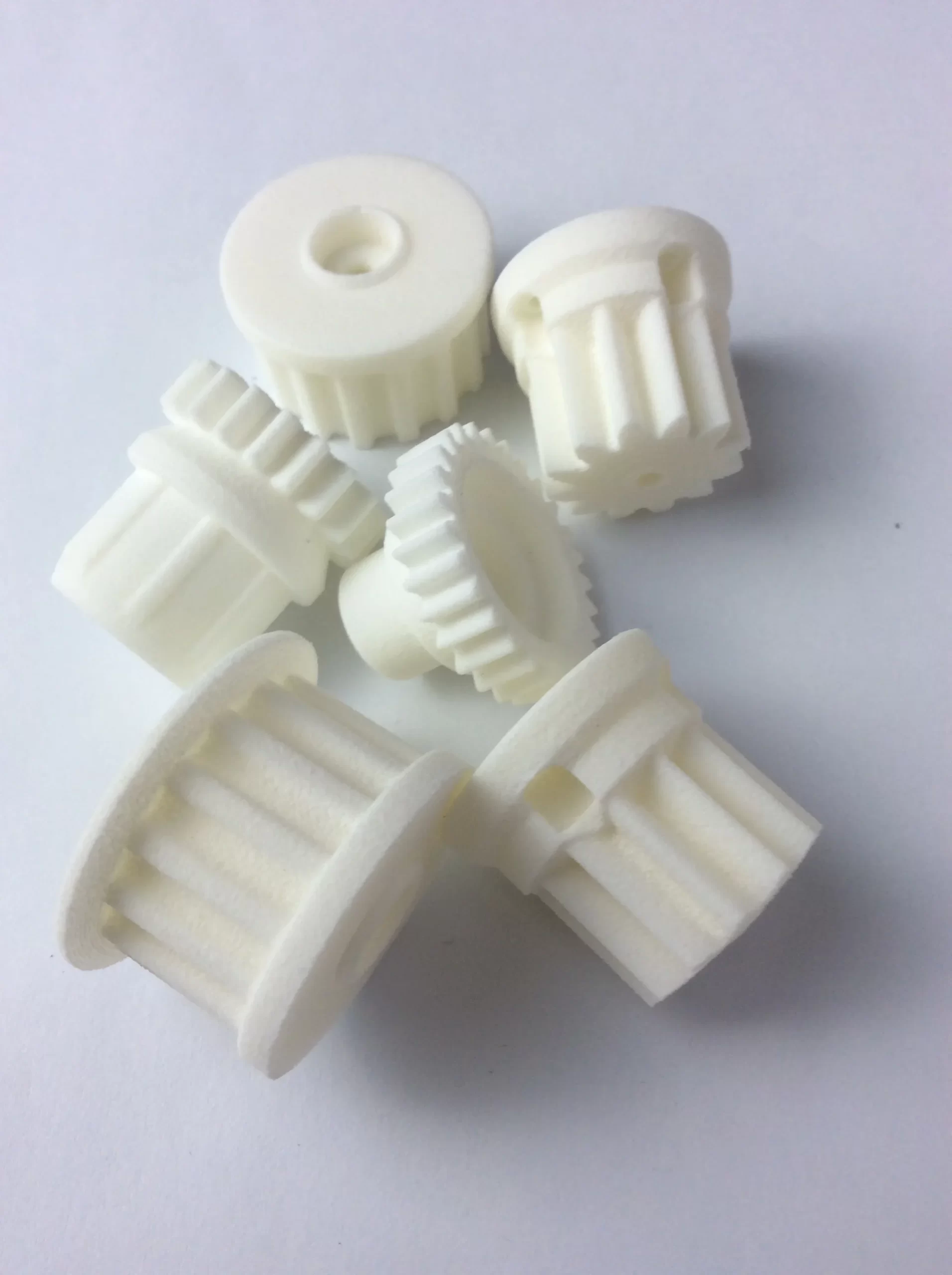
SLS 3D printing is an advanced technique in which a laser selectively fuses powdered material into a solid object. Each layer is accurately built from a CAD model, without the need for support structures. This creates durable parts with plenty of design freedom. Discover with our selection matrix whether SLS printing is the right choice for your project.
When do you choose SLS 3D printing?
SLS printing is ideal for making strong, lightweight parts with complex geometries. Because no support material is required, internal cavities or overhangs can also be printed well. The technique is particularly suitable for:
- Functional prototypes
- Industrial parts for intensive use
- Complex shapes that are difficult with other techniques
Thanks to its high precision and material properties, SLS 3D printing is popular in mechanical engineering, aerospace, automotive and consumer electronics. Use our free calculator to calculate the cost of your project within minutes.
How does SLS 3D printing work?
During the SLS printing process, a thin layer of powder (usually nylon) is spread and heated to just below its melting point. A laser then selectively sinters the powder based on the digital design. Each layer is fused with the previous one until the object is complete. The excess powder acts as a natural support, making complex shapes easy to print. After printing, the build platform cools to prevent distortion. Then the loose powder is removed and recycled. Depending on requirements, finishing operations such as blasting, coloring or vapour smoothing follow.

SLS printing for durable, functional parts
Rapid Prototyping as a partner in SLS
Want strong, accurate plastic parts that really function in real-world applications? At Rapid Prototyping, we translate your design into high-quality end products at lightning speed with our expertise in SLS printing. Whether it's functional prototypes, housings or custom components for series production. We think with you from the very first design. Upload your 3D file directly or schedule a no-obligation consultation. Together we provide a reliable, scalable and future-proof solution.
Use the choice matrix to compare SLS
Unsure if SLS printing is the right choice? Our choice matrix helps you compare with other techniques:
SLS vs. SLA
SLS delivers strong functional components. SLA provides high detail accuracy and smooth surfaces, but is less suitable for heavy loads.
SLS vs. FDM
FDM is cheaper, but provides weaker parts with rougher surfaces. SLS offers better mechanical properties and more geometric freedom.
SLS vs. CNC milling
SLS is ideal for complex shapes and internal structures. CNC milling is more accurate for simple geometries, especially in metal or hard plastics.
Benefits of SLS printing in Rapid Prototyping.
At Rapid Prototyping, we work with professional SLS printers, which ensures short lead times and competitive rates. By cleverly combining orders, we reduce production costs without compromising on quality.
Our advantages:
- Fast delivery time compared to competitors
- Affordable and good quality
- Experience since 1996 in SLS printing technology
- No support material required
- Experts in flawless preparation and post-processing
SLS 3D printing requires expert knowledge. Our team prevents common mistakes such as incorrect temperature settings or deformations, so your parts are ready for immediate use.
Frequently asked questions about SLS printing
What materials are used in SLS printing?
Especially nylon (PA12), glass-filled nylon (PA12/GF) and other technical polymers with strong mechanical properties.
Is SLS print suitable for scale production?
Yes, very suitable for small to medium series (1-1000 pieces) without support structures.
How accurate is SLS 3D printing?
Average tolerances are ±0.2 mm, depending on the model and size.
Are SLS parts durable?
Sure. They are resistant to mechanical stress, heat and chemical influences - ideal for long-term industrial use.
What is the delivery time for an SLS print?
Usually 3 to 4 business days, sometimes faster depending on ongoing production.
What are the advantages of PA12 over other printing materials?
PA12 is strong, abrasion-resistant, highly resistant to chemicals and has excellent dimensional stability. It is also biocompatible (skin contact), food safe and suitable for functional applications.
How does SLS 3D printing actually work?
SLS stands for Selective Laser Sintering - an advanced 3D printing technique that allows us to create strong and functional plastic parts without support or post-processing during printing.
The process begins with a thin layer of powder, usually nylon (PA12 or PA11). A laser then scans the contours of the part and fuses the powder together where needed. Is the first layer finished? Then a new layer of powder comes on top, and the process repeats itself - layer by layer - until the complete part is built.
What makes SLS so convenient is that it requires no support equipment. The loose powder surrounding the part acts as a natural support, making it easy to print even complex shapes and internal structures.
When the print is finished, the printer cools slowly. Then the parts are removed from the powder and then blasted and post-processed as needed. The result: strong, precise parts that can be used immediately - whether for prototypes, functional test parts or small production runs.
How accurate is SLS printing with PA12?
SLS supplies parts with high accuracy, typically we adhere to ISO 2768M with a minimum ±0.2mm for small parts and ±0.4mm for large parts.
Do SLS parts need support materials?
No, that's a big advantage of SLS. The unused powder around the part supports the printing process, allowing complex shapes and internal channels without supports.
What is the maximum size for SLS PA12 parts?
It is possible for us to print parts up to 700mm in PA12. For PAGF this is about 450mm.
Is PA12 suitable for functional use or finished products?
Certainly. PA12 is ideally suited for functional prototypes, small production runs or even finished products. Think of housings, clips, connectors and hinge parts.
Through printing, the same is possible to add functionalities directly to your design. Think of internal channels for air and water applications or, for example, integrate grids for certain filter options.
What finishes are possible after printing?
After printing, parts are standard blasted. This gives you white parts with a light sandpaper-like surface.
To further gold plating, parts can be drummed also known as slide grinding or chemically polished, vapor polishing. Vapor polishing is a more expensive option for gold plating SLS parts, but the parts come very close to injection molding in terms of surface area, and in addition, the colors from color impregnation get a lot deeper.
In addition, we have the option of waterproofing mainly thin-walled parts using nanoimpreg. In addition, it helps counteract the water absorption of PA12.
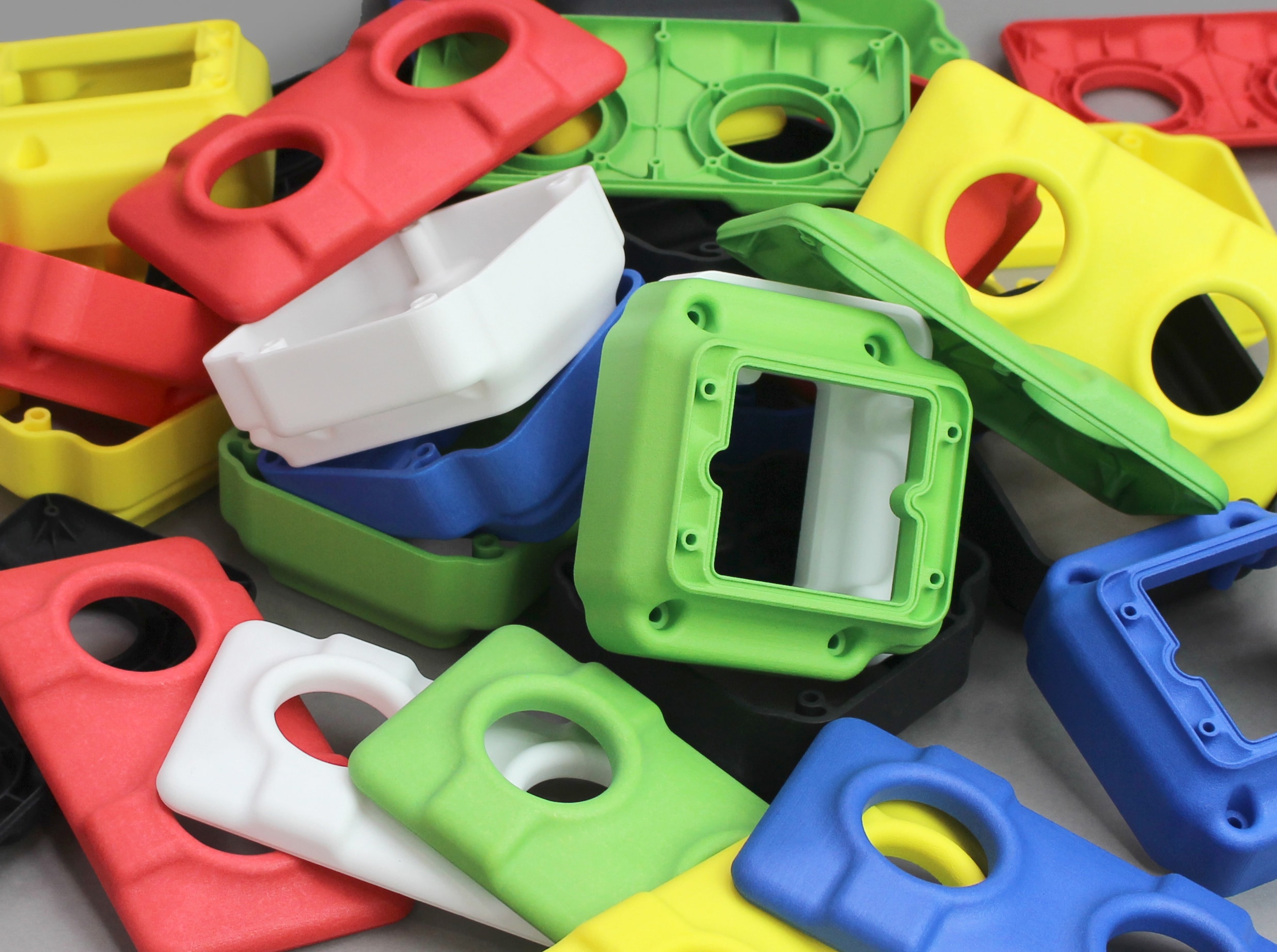
Last option is to color the white parts by color impregnation. For this we have a number of standard colors. If a specific color is desired, this can be discussed.
It is also possible to insert inserts into the parts.